Fish Sauce: What It Is, How to Use It and Substitutes
What is fish sauce?
To make fish sauce, small fish, usually anchovies, are layered with salt in wooden barrels or clay jars. Over many months, often a year or more, the fish’s own enzymes break down the protein. This releases a liquid that is drained off and filtered. The first draw is considered the best. In Thai the sauce is called nam pla, in Vietnamese nước mắm and in the Philippines patis. A barrel of fish yields far less sauce than the amount of fish that went in. Well-known Vietnamese places of origin are the island of Phu Quoc and the coastal town of Phan Thiet. The Romans already knew a similar sauce called garum. It was made from fish scraps and traded throughout the Mediterranean.
Flavour and uses
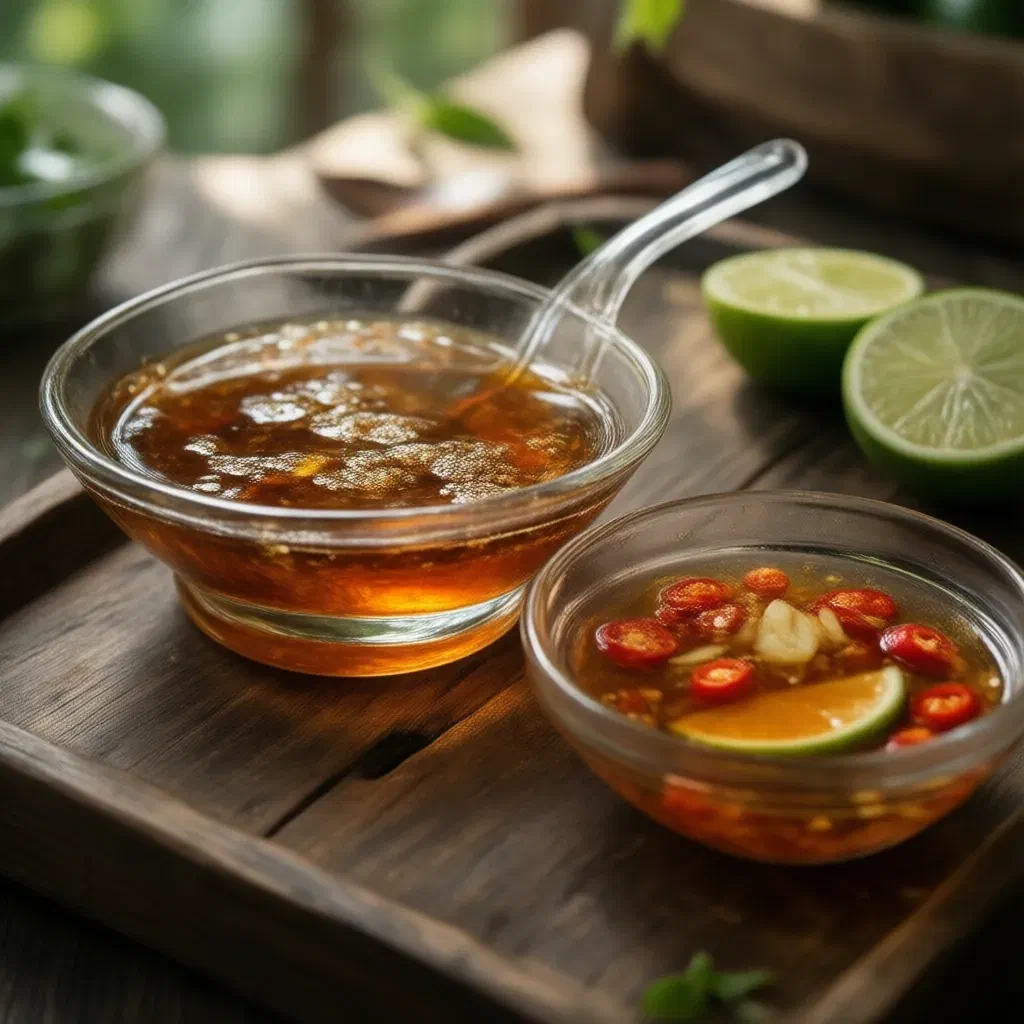
Fish sauce is very salty and brings plenty of umami. The fishy smell almost entirely disappears during cooking. It seasons curries, soups, stir-fries and salad dressings, often instead of salt. In pad thai with prawns it forms the sauce together with tamarind and palm sugar. For Thai green curry it goes into the coconut milk at the end. In Vietnam it is stirred with lime juice, sugar, water, garlic and chilli to make nuoc cham, the dip for spring rolls. Start with a teaspoon per serving and taste as you go. Too much fish sauce cannot be undone, too little can. A dash also works in tomato sauce or bolognese, without anyone tasting fish.
Buying fish sauce: what to look for
You will find fish sauce in the Asian section of larger supermarkets, and Asian grocers have a wider choice. Good fish sauce contains only anchovies and salt, sometimes a little sugar. Additives such as hydrolysed protein, flavourings or MSG point to a simpler product. Vietnamese bottles often state a value in degrees N, such as 30°N or 40°N. This is the nitrogen content in grams per litre, a measure of the protein content. The higher it is, the stronger the sauce. A light, clear colour suggests a fresh product. For vegetarians there is fish sauce made from seaweed and soy.
Storage and shelf life
Thanks to its high salt content, fish sauce hardly ever spoils. Once opened, it keeps for about a year in a cool, dark place, and longer in the fridge. Over time it darkens and tastes more intense. Salt crystals at the bottom of the bottle are harmless. Always close the bottle tightly, otherwise the smell spreads through the cupboard.
What can you use instead of fish sauce?
For 1 tablespoon of fish sauce, stir 1 tablespoon of light soy sauce with ½ teaspoon of light miso paste and a few drops of lime juice. This matches the salt and umami fairly well, only the taste of the sea is missing. You can add it by letting a small piece of nori steep in the mixture for ten minutes. If you eat fish, mash an anchovy fillet from a jar into 1 tablespoon of soy sauce.