National Dish Afghanistan: Kabuli Palau (Recipe)
In this article
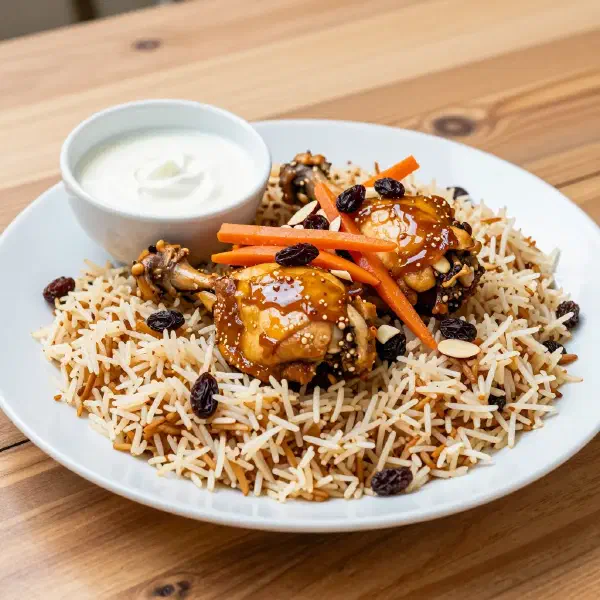
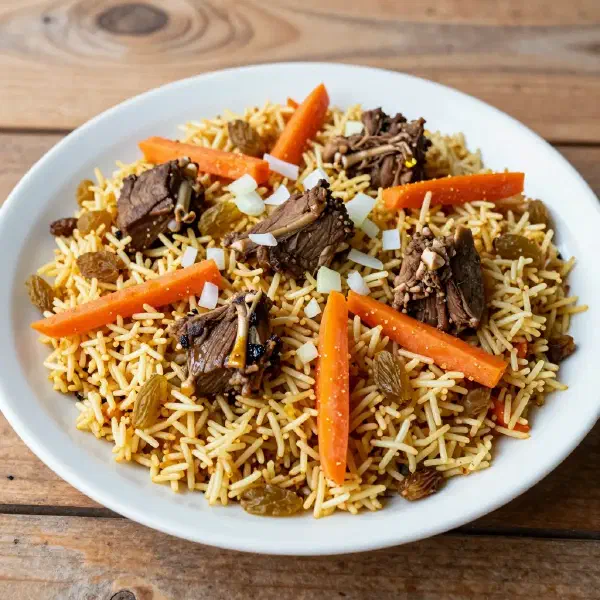
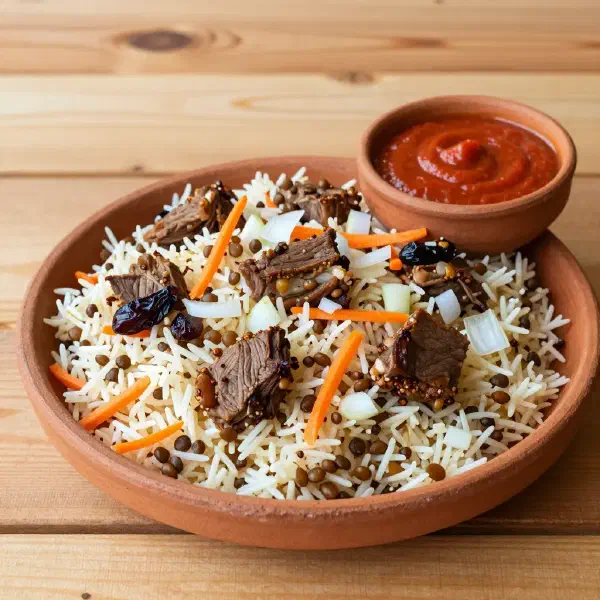
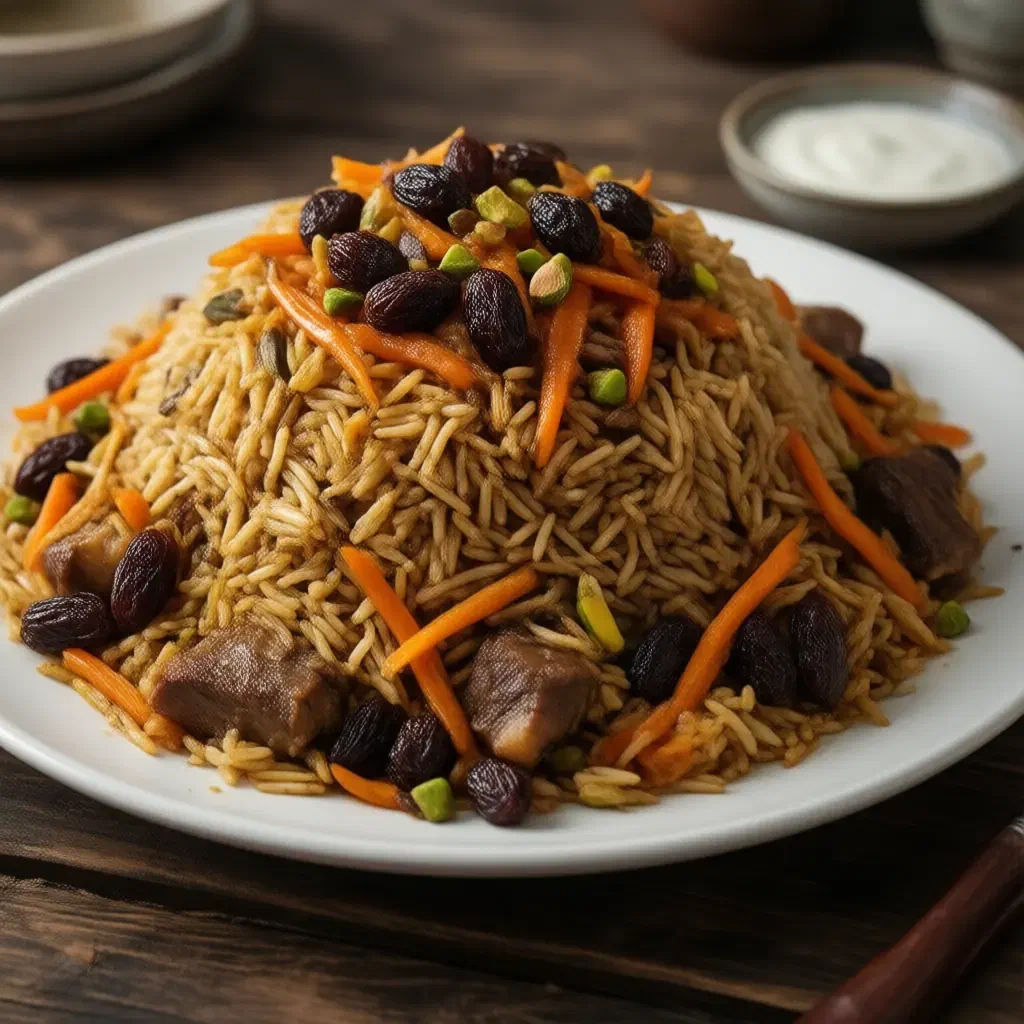
When Afghans have guests to feed, a large platter of Kabuli Palau usually takes pride of place on the table. Beneath the loose, light brown rice lies tender braised lamb, and on top glisten strips of carrot and raisins. The seasoning is warm and mild, with cumin and cardamom but no heat at all. The recipe takes about two hours, though for most of that time the meat simply braises on its own.
About Kabuli Palau
Kabuli Palau is a rice dish with lamb that is regarded as the national dish of Afghanistan. In Afghanistan it is usually called Qabili Palau. Whether the name comes from the capital, Kabul, or from the Dari word qabil, meaning accomplished or excellent, is disputed. Palau is the Afghan word for a dish of steamed rice cooked in stock. The meat is first braised with deeply browned onions, and this stock later turns the rice a light brown. The contrast in flavour is typical. The rice tastes savoury, of lamb and spices, while the fried carrots and raisins on top bring sweetness. Kabuli Palau is served at weddings, on holidays such as the festival of breaking the fast, and whenever guests come to visit. It usually comes with a yoghurt with cucumber or a hot green chilli sauce.
Ingredients (serves 1–2)
- 350 g lamb shoulder on the bone (cut into 3 to 4 pieces) or 250 g boneless lamb
- 150 g basmati rice
- 1 large onion
- 4 tbsp sunflower oil or rapeseed oil
- 500 ml water
- 1 tsp cumin seeds (whole)
- 1 tsp char masala (an Afghan spice blend of cumin, cardamom, cinnamon, cloves and black pepper)
- 3 green cardamom pods
- 1 large carrot
- 40 g dark raisins (seedless)
- 1 tsp sugar
- 1 tbsp chopped almonds or pistachios (optional)
- Salt
Shopping for the ingredients
You will find lamb shoulder on the bone at the butcher’s or at the meat counter of Turkish and Arab grocers. Ask them to saw it into large pieces for you while you are there. The bone gives the stock flavour, but plain leg meat works too. For the rice, a long-grain basmati is worth it; in Afghan shops it is also sold as sella rice. It is parboiled and stays especially separate when steamed. Char masala is available in Afghan shops and online. If you cannot get it, mix your own from half a teaspoon each of ground cumin and cardamom with a pinch each of cinnamon, clove and pepper. The raisins should be soft and dark; Afghan grocers stock long green or black varieties for this.
Preparing the dish
Wash the rice in a bowl of cold water until the water runs almost clear; 4 to 5 changes are usually enough. Then soak the rice for at least 30 minutes in fresh water. Peel the onion, halve it and cut it into thin half-rings. Peel the carrot and cut it into matchstick-thin batons about 4 cm long. Briefly rinse the raisins and pat them dry, otherwise the oil will spit. Pat the meat dry and salt it lightly all over.
Step-by-step instructions
- Heat the oil in a heavy pan and fry the onion rings over a medium heat, stirring, for 12 to 15 minutes until deep brown but not black.
- Add the lamb and brown it on all sides for 5 minutes, then briefly toast the cumin, cardamom pods and half a teaspoon of char masala with it.
- Pour in 500 ml water, add 1 tsp salt and braise the meat, covered, over a low heat for 60 to 75 minutes until tender.
- Meanwhile, heat 1 tbsp oil in a small frying pan, fry the carrot batons for 4 minutes, sprinkle over the sugar and glaze for another 2 minutes, then lift them out.
- In the same oil, toss the raisins for 1 to 2 minutes until they puff up, and add them to the carrots.
- Lift the meat out of the pan and keep it warm. Measure the stock and top it up with water to 300 ml, or reduce it, then season it generously.
- Drain the soaked rice, add it to the boiling stock, stir in the remaining char masala and cook uncovered over a medium heat until the liquid is almost absorbed, about 8 to 10 minutes.
- Press the meat into the rice, lay the carrots and raisins on top, seal the pan tightly with a cloth under the lid and steam over the lowest heat for 25 to 30 minutes.
- To serve, heap the rice onto a platter, place the meat on top or underneath, and scatter over the carrots, raisins and, if you like, almonds or pistachios.
Gluten-free / lactose-free version
Kabuli Palau is naturally gluten-free and lactose-free. Rice, lamb, vegetables, oil and spices contain neither gluten nor milk. Just check the ingredients list on ready-made spice blends, as some contain flour as an anti-caking agent. If you serve yoghurt with the palau, you can use lactose-free yoghurt or a soya yoghurt. Mix your own char masala and you are on the safe side.
Tips for vegans and vegetarians
For a vegetarian version, cook 200 g of cooked chickpeas in a well-flavoured vegetable stock with the browned onions instead of the lamb. The onions can go a little darker in this case, as they replace much of the meaty flavour. 150 g of diced pumpkin or aubergine, briefly fried and tucked under the rice, makes the dish more filling. Made this way, the dish is vegan too. Toasted almonds go especially well at the end.
More tips and tricks
Most depends on the onions. If they are only golden, the rice stays pale and tastes flat. If they turn black, everything becomes bitter. Stir constantly during the last few minutes. Do not stir the rice once it is in the pan, or the grains will break. The cloth under the lid catches the steam, so the rice turns out fluffy and dry. Leftovers keep for 2 days in the fridge. To reheat, add 2 tbsp water and warm through, covered, over a low heat.
Adapting the recipe to your taste
For family celebrations the quantities are multiplied. Allow 75 g rice and 150 to 200 g meat per person. Many families now use beef or chicken thighs instead of lamb; with chicken the braising time drops to 35 minutes. If you like it sweeter, increase the sugar for the carrots to 2 tsp. A pinch of saffron in the stock gives the rice a golden tone.
Ingredient substitutions
Lamb shoulder can easily be replaced with beef neck. Instead of raisins, chopped dried apricots or barberries work well; barberries bring more acidity. If you cannot get char masala, use garam masala, which contains a little more pepper and coriander. Ghee can stand in for the sunflower oil, though it does contain traces of milk protein and lactose.
Drink pairing ideas
In Afghanistan people drink green tea with their meal, often brewed with a cardamom pod, and more of it afterwards. Dugh goes well too, a salty yoghurt drink with dried mint. If you would like something cool and fruity, mix pomegranate juice with sparkling mineral water.
Serving and presentation ideas
Kabuli Palau is traditionally served on a large, flat platter that everyone eats from together. Heap the rice into a low mound, place the meat in the middle and spread the carrots and raisins over it in a thick layer. Chopped pistachios add flecks of green. Alongside, set a bowl of Raita and a warm Naan.
A bit of history
Rice dishes of this kind are found throughout Central Asia, Iran and the Indian subcontinent, where they go by names such as polo, plov or pulao. How and when exactly they spread is not clearly documented. What is certain is that Kabuli Palau is now regarded as the national dish of Afghanistan. Whether it originated in Kabul or comes from the north of the country, where it is close to Uzbek plov, has not been settled. The dish is associated with celebrations and hospitality. In recent decades Afghan families have taken the recipe with them to Pakistan, Iran and Europe.
More recipe ideas
For more ideas, explore all our Afghan recipes.
Summary: Kabuli Palau
Deeply browned onions for colour, tender braised lamb for the stock and a cloth-wrapped lid for fluffy rice. That is what decides whether this palau succeeds. The carrots and raisins are fried separately and only laid on top for the steaming. Allow two hours, of which only about 40 minutes is actual work.