National Dish Afghanistan: Qabili Palau with Chicken (Recipe)

In this article
Traditionally, Afghanistan’s festive rice is cooked with lamb, but it works just as well with chicken. Qabili Palau with chicken cooks faster and tastes milder, yet it stays true to the original. The rice soaks up the brown onion broth, and sweet carrot strips and glossy raisins go on top. With a bowl of yoghurt on the side, it makes a complete dinner.
About Qabili Palau with Chicken
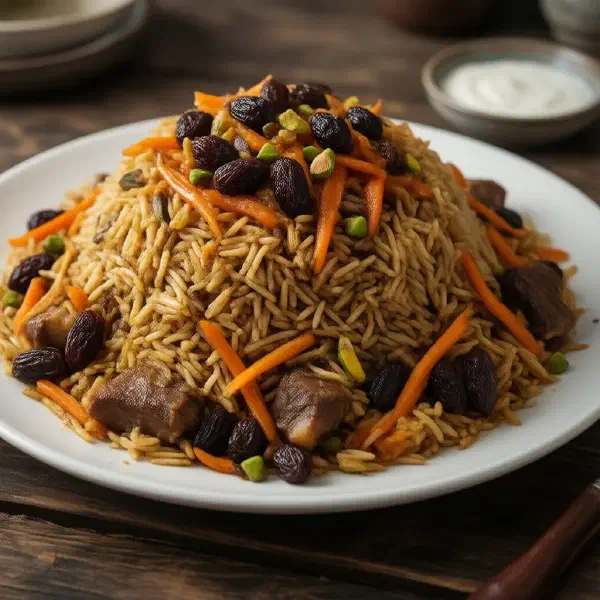
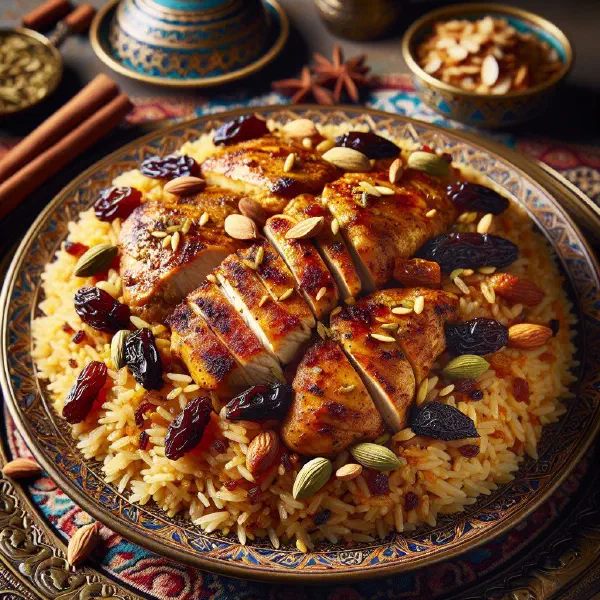
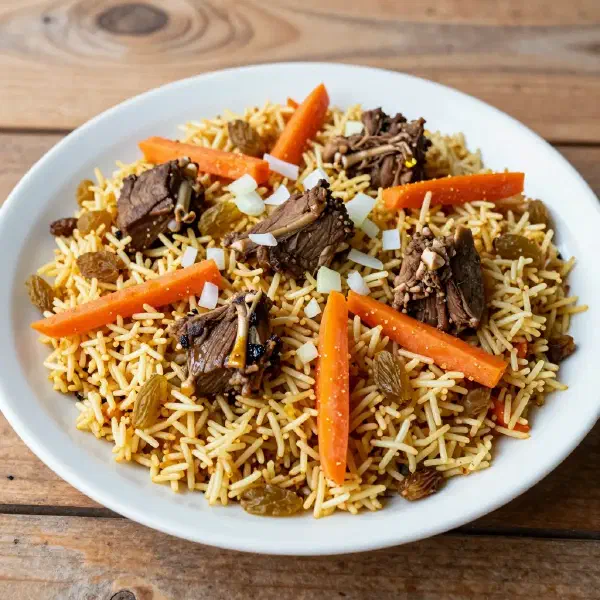
Qabili Palau with chicken is the chicken version of Afghanistan’s national dish. The original is made with lamb or mutton, but with chicken thighs the principle stays the same. Onions are fried until dark, the meat cooks in them to make a rich broth, and the basmati rice then swells in that broth. The onions turn the rice light brown. On top go carrot strips fried in oil with sugar and raisins, sometimes with almonds or pistachios as well. The dish is savoury and slightly sweet at the same time. It is reminiscent of Pakistani Yakhni Pulao, but much less spicy.
Ingredients (serves 1–2)
- 2 bone-in chicken thighs (about 450 g together) or 300 g boneless chicken thigh meat
- 150 g basmati rice
- 1 large onion
- 5 tbsp sunflower oil or rapeseed oil
- 500 ml water
- 1 tsp cumin seeds (whole)
- 1 tsp char masala (Afghan spice blend of cumin, cardamom, cinnamon, cloves and black pepper)
- 3 green cardamom pods
- 1 large carrot
- 40 g dark raisins (seedless)
- 1 tsp sugar
- 1 tbsp flaked almonds or chopped pistachios (optional)
- Salt
Shopping for the ingredients
For Qabili Palau you need a long-grain basmati rice, ideally an aged one from an Indian or Pakistani grocer. It stays separate and fluffy after steaming. Bone-in chicken thighs give a richer broth than breast fillet, which also dries out quickly. You can buy char masala in Afghan shops or online. Alternatively, mix a pinch each of ground cinnamon, cloves, cardamom and pepper with a little cumin. The raisins should be soft and dark; Afghan shops stock long green and black varieties for this.
Preparing the dish
Wash the rice in three to four changes of water until the water runs almost clear, then soak it in cold water for 30 minutes. Slice the onion into thin half-rings. Peel the carrot and cut it into matchstick-thin strips about 5 cm long. Pat the chicken thighs dry. Wrap the pan lid in a clean tea towel for later. This keeps the steam in the pan during steaming and stops condensation dripping back onto the rice.
Step-by-step instructions
- Heat 4 tbsp oil in a heavy pan and fry the onion rings over a medium heat for 12 to 15 minutes, stirring, until dark brown but not burnt.
- Add the chicken thighs and brown them on all sides for 5 minutes, then add the cumin, the lightly crushed cardamom pods and 1 tsp salt and toast briefly.
- Pour in 500 ml water, cover and simmer over a low heat for 30 minutes until the meat is cooked through.
- In a small frying pan, heat 1 tbsp oil, fry the carrot strips for 4 minutes, sprinkle over the sugar and add the raisins for the last minute, until they puff up.
- Take the chicken out of the pan, measure 250 ml of the broth and bring it to the boil in the pan with the char masala. Set the rest of the broth aside.
- Drain the rice, add it to the boiling broth and cook uncovered for 6 to 8 minutes until the liquid has disappeared from the surface.
- Pile the rice into a mound, tuck the chicken into it, lay the carrots and raisins on top and use the handle of a wooden spoon to poke three holes down to the bottom.
- Put the wrapped lid on and steam the rice on the lowest heat for 25 minutes, or for the same time in the oven at 150 °C (conventional heat).
- Arrange the rice on a platter with the chicken inside or on top, and scatter over the carrots, raisins and almonds.
Gluten-free / lactose-free version
Qabili Palau with chicken is naturally gluten-free and lactose-free. Rice, chicken, vegetables, oil and whole spices contain neither gluten nor milk sugar. If you use a ready-made char masala, check the ingredients list, as some producers bulk out spice blends with flour. If you are lactose intolerant, replace the yoghurt that is often served with it with lactose-free yoghurt or soya yoghurt with a little salt and dried mint.
Tips for vegans and vegetarians
For a vegetarian and vegan version, replace the chicken with 250 g cooked chickpeas and 150 g button mushrooms, quartered. Fry the mushrooms with the onions and use 400 ml strong vegetable stock instead of water. The cooking time for the broth then drops to 15 minutes. If you would like more protein, add 150 g firm smoked tofu, diced, fried separately until crisp and laid on top only at the end.
More tips and tricks
The most common mistake is onions that are too pale. Only when they are properly dark brown does the rice get its colour and deep flavour. Do not stir the rice once it has come to the boil, or it will break and turn sticky. If it still has bite after steaming, drizzle over 2 tbsp of the reserved broth and steam for another 10 minutes. Leftovers keep in the fridge for two days. Reheat them covered with a splash of water so the rice does not dry out. For four people, double all the quantities and use a wider pan.
Adapting the recipe to your taste
If you like more heat, add a dried chilli to the broth or serve a green chilli sauce alongside. For more crunch, scatter toasted pistachios and slivered almonds over the carrots. Some families also lay strips of orange peel on the rice, which recalls Iranian Shirin Polo. Instead of thighs you can use chicken wings, which make the broth even richer.
Ingredient substitutions
Instead of basmati, another long-grain rice will do, though it is a little less fragrant. Some of the carrots can be replaced with strips of pumpkin. You can swap the dark raisins for chopped dried apricots or barberries; barberries bring sourness rather than sweetness. If you have no char masala, a mix of a pinch of cinnamon, two crushed cloves and freshly ground pepper is enough. Ghee instead of oil gives a more buttery flavour.
Drink pairing ideas
In Afghanistan, palau is mostly served with green tea with cardamom, either unsweetened or with sugar cubes. Dogh, a salty yoghurt drink with cucumber and dried mint, also goes well. If you prefer something cold and fruity, mix pomegranate juice with sparkling mineral water. A pot of freshly brewed mint tea rounds off the meal.
Serving and presentation ideas
Serve Qabili Palau on a large, flat platter, as is the custom in Afghanistan. Pile the rice into a mound, half-hide the chicken in it and spread the carrots and raisins thickly over the top. A few green pistachios add colour. Serve with a small bowl of yoghurt with cucumber, flatbread such as Pakistani naan and a simple tomato and onion salad.
A bit of history
Kabuli or Qabili Palau is regarded as the national dish of Afghanistan. Where the name comes from is not clear. One explanation links it to the city of Kabul, another to the Persian word qabil, meaning capable or worthy. The dish probably does not come from Kabul itself, but rather from northern Afghanistan on the border with Uzbekistan. Rice dishes of this kind belong to the large family of pilaf dishes, found from Persia through Central Asia to South Asia. The classic version is cooked with lamb or mutton. Chicken is a variation that cooks faster and tastes milder.
More recipe ideas
For more ideas, explore more Afghan recipes.
Summary: Qabili Palau with Chicken
Qabili Palau with chicken follows the method of the festive rice but takes only a little over an hour. What matters most are dark-fried onions, a rich chicken broth and gentle steaming without stirring. The sweet carrots and raisins on top are what make the dish. Yoghurt and green tea complete it.