National Dish Benin: Wagassi (Recipe)
In this article
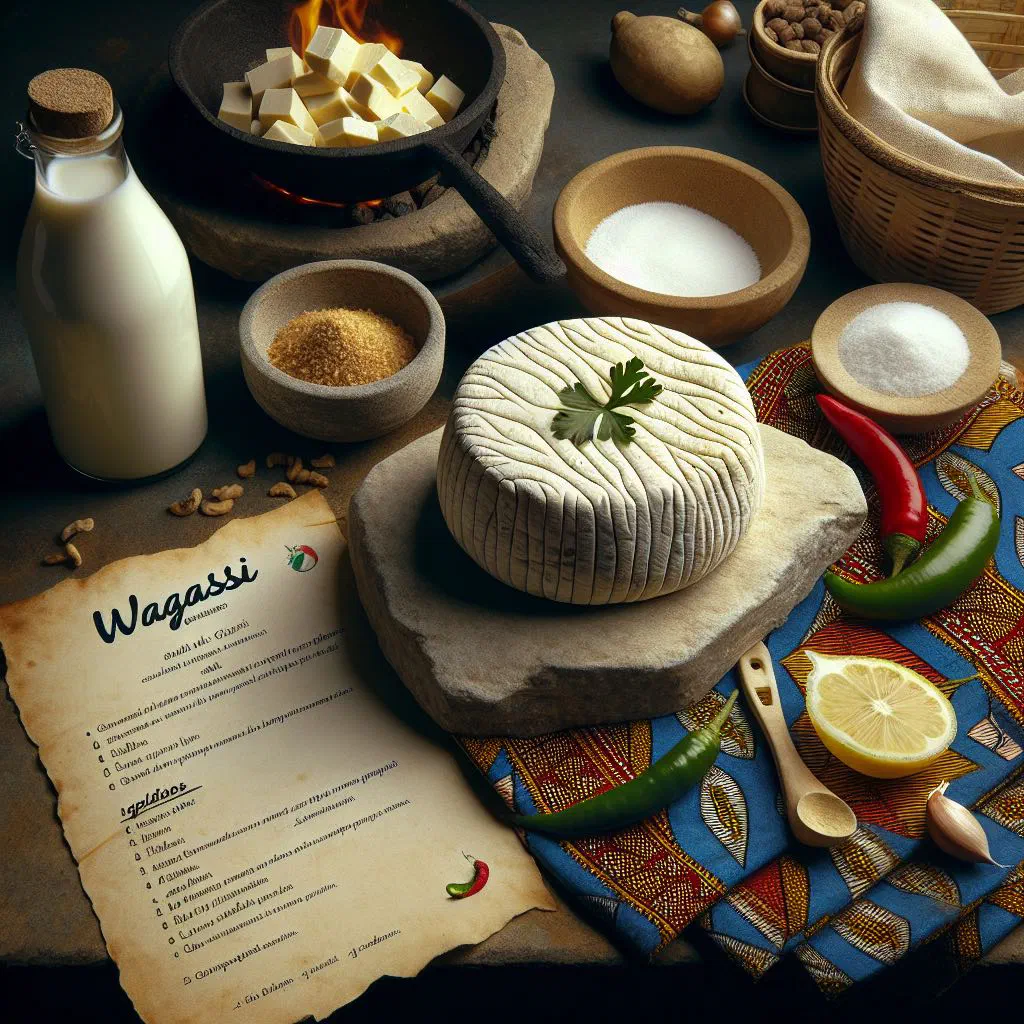
Wagassi is the fresh cheese of the Fulani herders of northern Benin — milk curdled with plant juice or lemon, pressed into rounds and often dyed a striking orange with sorghum leaves. Sliced and fried until the outside crisps while the inside stays soft and squeaky, it turns up in markets, at roadside grills and in stews throughout the region.
About Wagassi
Wagassi is a traditional fresh cheese produced by Fulani communities in northern Benin, made from cow’s milk curdled using the sap of the Calotropis plant or, more practically at home, lemon juice or rennet. The curds are drained and pressed into flat rounds that can be eaten fresh, fried or simmered into sauces. Fried wagassi, golden crust, yielding centre, is by far the most popular preparation and a genuine street food staple.
Ingredients (serves 1–2)
- 1 litre whole milk (not UHT if possible)
- 2 tablespoons fresh lemon juice, or 1 teaspoon liquid rennet
- A pinch of salt
- 1 tablespoon vegetable oil, for frying
- Optional: a pinch of ground chilli
Shopping for the ingredients
Fresh whole milk is essential, UHT milk does not curdle reliably and gives a poor yield. Liquid rennet is sold in pharmacies, health food shops and online, and gives a firmer curd than lemon juice, which is worth it if you can find it. You will also need muslin or a clean cotton cloth for draining.
Preparing the dish
Warm the milk slowly and watch the temperature: too hot and the curd turns rubbery. Line a sieve with muslin and set it over a bowl. Have a small weight ready, a plate with a tin on top does the job, for pressing the cheese into shape once it has drained.
Step-by-step instructions
- Heat the milk gently to about 80 °C, stirring so it does not catch.
- Remove from the heat and stir in the lemon juice or rennet.
- Let it stand undisturbed for 10–15 minutes, until the curds separate clearly from the whey.
- Pour into a muslin-lined sieve and let it drain for 20 minutes.
- Gather the cloth, shape the curd into a flat round and press under a light weight for 1 hour.
- Cut into thick slices or cubes and season with salt.
- Fry in hot oil for 2–3 minutes per side, until golden and crisp at the edges.
Gluten-free / lactose-free version
Wagassi is naturally gluten-free. It contains dairy by definition, though much of the lactose leaves with the whey; for a lactose-free version, lactose-free milk curdles the same way and gives a comparable cheese.
Tips for vegans and vegetarians
The cheese is vegetarian if you use lemon juice or a microbial (non-animal) rennet, check the label, as traditional rennet is animal-derived. For a vegan alternative, firm tofu marinated in lemon and salt and fried the same way fills the role convincingly, since the pleasure here is largely in the crisp crust and soft centre.
More tips and tricks
Do not boil the milk; 80 °C is hot enough and keeps the curd tender. Press it just firmly enough to hold together, over-pressing makes the cheese dense and dry. And fry it in a properly hot pan so it colours before it softens, otherwise it slumps.
Adapting the recipe to your taste
In northern Benin the cheese is often coloured with sorghum leaves, giving the characteristic orange rind. A pinch of chilli in the salt is common. Fried wagassi is also excellent simmered briefly in a tomato and onion sauce, which is how it appears as a main course.
Ingredient substitutions
Vinegar can replace lemon juice as the acid, though the flavour is sharper. Goat’s milk works and gives a tangier cheese. Halloumi is the closest widely available substitute if you want the frying experience without making cheese from scratch.
Drink pairing ideas
Bissap (hibiscus juice) or ginger juice are the standard Beninese accompaniments and cut the richness of the fried cheese well. Palm wine is the traditional alcoholic choice. A cold lager works just as well with fried wagassi as a snack.
Serving and presentation ideas
Serve wagassi hot from the pan, cut into cubes, with a sprinkle of chilli salt and a squeeze of lime. It belongs on a plate beside grilled meat and fried plantain, or skewered on a toothpick as a snack. It is at its best within minutes of frying.
A bit of history
The Fulani are West Africa’s great cattle-herding people, moving with their animals across the Sahel, and cheesemaking allowed them to preserve milk on the move. Wagassi is one of the few traditional cheeses in a region where dairy is otherwise rare, and it remains closely associated with Fulani communities in northern Benin and neighbouring countries. It offers a genuine window onto Beninese cuisine.
More recipe ideas
Summary: Wagassi
Wagassi is fresh Fulani cheese from northern Benin, milk, acid, a cloth and an hour under a weight. Fry the slices until golden and serve them hot with chilli salt, and you have one of West Africa’s most underrated snacks.